AI Adoption in the Asia-Pacific: Pathways to Economic Opportunities
Hildegunn Kyvik Nordås, Ammar Younas and Yi Zeng | 20 November 2026
Trade, Blog | Tags: APEC, Artificial Intelligence, Economic Growth, Employment
The State of the Region 2026-27 report from the Pacific Economic Cooperation Council (PECC) examines the economic outlooks and challenges facing the Asia-Pacific, focusing on the adoption of artificial intelligence (AI) and its implications for the region’s future growth and development. A region-wide survey with more than 500 respondents shows a relatively high AI adoption rate in the Asia Pacific. While most respondents have experienced gains from AI adoption in their organization, few reported layoffs or changes in recruitment (Figure 1).
Figure 1. Changes in own organization following AI adoption
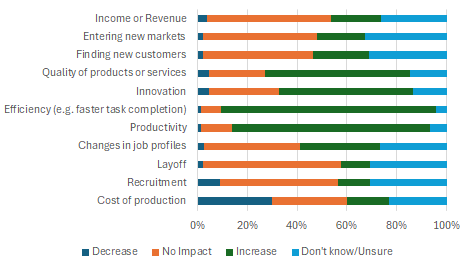
Note: 578 individuals from 23 economies responded to the survey. Business accounted for 23% of the respondents.
Source: PECC (2026)
Enterprise surveys of AI adoption reported in the literature show that intensive AI adoption by business remains concentrated among firms, sectors and economies with complementary skills, infrastructure, data and organizational capabilities. Micro, small and medium-sized enterprises that adopt AI report higher relative efficiency gains than large enterprises but face the steepest structural barriers to entry.
Like other major technology shifts in the past, reaping the full benefit of AI requires complementary investment in human and organizational capital. Such investments need to be made not only in the AI-adopting enterprise, but also by suppliers and customers. Furthermore, economy-wide investment in skills and connectivity as well as a regulatory framework that promotes trust and minimizes legal uncertainty are crucial. Finally, AI helps streamline global value chains and reduce transaction costs, while trade and investment channels provide firms with the data, compute, and tools needed to adopt AI. Respondents to the PECC survey expect lack of such complementary assets to hinder future AI adoption (Figure 2).
Figure 2. Factors expected to hinder AI adoption next year
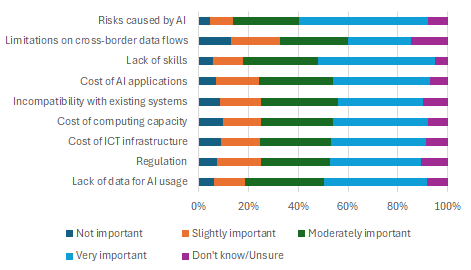
Note: 578 individuals from 23 economies responded to the survey. Business accounted for 23% of the respondents.
Source: PECC (2026)
Health and education show where the constraint sits. In health, reliance arrangements between regional regulators are already operational. Nonetheless, with regulatory capacity distributed unevenly, clinicians wait longer for AI tools already in routine use elsewhere in the region. In education, teacher capability is the binding constraint in most systems that have moved past pilots. UNESCO’s 2024 AI competency frameworks for students and teachers give economies a shared vocabulary without requiring any of them to adopt another’s system.
Every APEC economy with recorded policy evidence in the AGILE Index, a comprehensive analysis of global AI governance capabilities, has an AI strategy that sets out specific measures or targets and addresses skills and ethics. However, the institutional capacity to implement AI governance frameworks varies considerably across APEC economies. While some have established regulatory, technical evaluation, standard-setting and certification mechanisms, others continue to face challenges in developing or operationalizing these capabilities. Going forward, APEC economies need to prioritize implementation of existing frameworks.
Major APEC economies are at the frontier of AI development and adoption while popular sentiment towards AI is more favorable than in many other regions. To foster inclusive AI-driven growth and shared prosperity key policy priorities include:
● Bridging the skills gap, including enhancing domestic and cross-border mobility of skilled professionals. This would foster knowledge and technology transfers and facilitate more wide-spread AI adoption.
● Modernizing the licensing system. When licensing systems are outdated, excessive or rigid, they often hinder enterprise AI uptake.
● Closing the digital divide. APEC economies should introduce best practice pro-competitive regulation and open markets for trade and investment in telecommunications and other digital infrastructure.
● Balancing data governance with open cross-border transfers: Large enterprises can overcome barriers through their own scale and proprietary datasets, whereas SMEs rely entirely on cross-border cloud platforms and off-the-shelf applications. Regional frameworks should promote privacy safeguards and cybersecurity standards that foster trust without shutting off cross-border data flows.
● Facilitating standardized interoperability. Addressing the legacy integration bottleneck requires governments and regional bodies to foster open, machine-readable standards and technical interoperability. By promoting shared standards, policy can accelerate the availability of modular, turnkey solutions that allow smaller enterprises to adopt AI without undertaking prohibitive custom development costs.
● Recognising each other’s conformity assessments. Member economies are building testing frameworks, model governance guidance and certification arrangements in parallel. Mutual reliance on each other’s evaluation results would cut duplicated cost for firms and conserve regulatory capacity that is scarce everywhere. Health offers the working precedent: reliance arrangements between device regulators in the region already allow a product authorised in one member economy to take an abridged route into another.
● Coordinating sandboxes and staged obligations. Several of the AI instruments now in force provide for regulatory sandboxes and phased transition periods, with longer periods for smaller firms. Designing these together would let smaller economies learn from the experience of larger ones without importing rules unsuited to their circumstances.
● Building administrative capacity. Adopting an instrument and administering it are different undertakings. Several statutes now in force still depend on subordinate regulations, technical guidance and risk classification frameworks that have not been written, and only around a third of member economies have impact assessment mechanisms, standards and certification arrangements, or a body able to evaluate an AI system before deployment. Assistance with drafting implementing rules, with evaluation capability and with supervisory training addresses this constraint directly, and its returns are economic rather than merely protective.
By acting on these priorities, Asia-Pacific economies can broaden the diffusion of AI beyond knowledge-intensive frontrunners and ensure that the productivity gains of the technology are shared more inclusively across firms of all sizes.
Related Posts

Who is Afraid of AI? Who Should Be?
Erik Engberg, Holger Görg, Mark Hellsten, Farrukh Jave, Magnus Lodefalk, Martin Längkvist, Natália Monteiro, Hildegunn Kyvik Nordås, Giuseppe Pulito, Sarah Schroeder and Aili Tang | 26 January 2026Trade, Policy Briefs | Tags: Artificial Intelligence, Employment, Innovation
What are the consequences of the rise in AI for workers? Will AI create or destroy jobs? Conceptually, AI can both substitute for and complement human labour.... continue reading

Governing AI for Humanity: Thoughts on the UN AI Advisory Body Interim Report
Hildegunn Kyvik Nordås | 8 April 2024Trade, Blog | Tags: Artificial Intelligence, Data Governance, Innovation
The awesome capabilities of AI applications have raised deep concerns about the future of work, democracy and even humanity itself - and a sense of urgency for establishing effective governance... continue reading

The Digital Transition of Services: Getting Regulation Right From the Start
Hildegunn Kyvik Nordås | 9 March 2023Trade, Blog | Tags: Competition, Digital Economy, Innovation, Privacy, Services Trade
The digital transition and the introduction of artificial intelligence (AI) in services are blurring the boundaries of both occupations and sectors. At the same time, new or rekindled trade-offs between... continue reading

Double Whammy? The Impact of Trade and Automation on High-Skilled Jobs
Hildegunn Kyvik Nordås and Franziska Klügl | 10 January 2022Trade, Blog | Tags: Artificial Intelligence, Employment, Services
As Artificial Intelligence (AI) capabilities for language, speech and image recognition pass human levels, AI-enabled software can perform white collar tasks previously done exclusively by high-skilled humans. Furthermore, white collar... continue reading

Is Artificial Intelligence Coming for Your Job?
Hildegunn Kyvik Nordås and Franziska Klügl | 13 July 2021Trade, Blog | Tags: Artificial Intelligence, Employment, Innovation
Artificial intelligence (AI) potentially generates big changes to the way we live and work. In a recent study we simulate the uptake of AI-enabled automation software in engineering and manufacturing.... continue reading